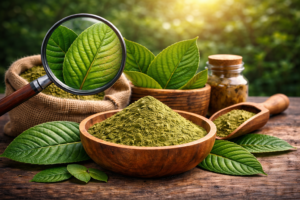
The presentation of kratom, whether in powder form or encapsulated, is not only a matter of consumer preference but also has direct implications for its chemical stability and the rate of degradation of its active compounds. Although both forms originate from the same plant material, differences in processing and interaction with the environment can influence alkaloid preservation and product integrity over time.
From a physicochemical perspective, one of the most relevant factors is the surface area exposed to the environment. Kratom powder has a larger surface area in contact with oxygen, which facilitates oxidation processes. This increased exposure can accelerate the degradation of sensitive alkaloids and promote changes in the chemical profile, especially if the product is not stored under optimal conditions. Oxidation, together with potential moisture absorption, represents one of the primary mechanisms of deterioration in this form.
In contrast, capsules act as a partial physical barrier between the kratom and the external environment. Although they are not completely airtight at the molecular level, they do reduce direct exposure to air, light, and moisture compared to loose powder. This effect can slow certain degradation processes, contributing to greater relative stability under similar storage conditions. However, this protection depends largely on the capsule material and the quality of the sealing process.
Another important aspect is the compaction of the material. In capsules, kratom is confined within a reduced volume, limiting air circulation between particles and reducing the rate of oxidative reactions. In the case of powder, especially when it is handled frequently or exposed to the surrounding environment, the constant renewal of air in contact with the product can accelerate these reactions.
However, capsules are not without limitations. The encapsulating material, typically gelatin or plant-based polymers, can also be affected by environmental conditions such as humidity and temperature. In environments with high relative humidity, capsules may absorb water, become deformed, or even compromise their structural integrity, indirectly affecting the kratom contained inside. Furthermore, if the product has been encapsulated under uncontrolled conditions, variations in density or material distribution may occur, introducing another source of variability.
From a storage perspective, kratom powder requires stricter control of environmental conditions to maintain its stability. Exposure to light, oxygen, and moisture should be minimized through the use of airtight, opaque containers. In the case of capsules, although there is an additional layer of protection, proper storage conditions are still necessary to prevent degradation of both the contents and the capsule shell itself.
In terms of chemical degradation, the differences between the two forms do not necessarily imply a complete loss of alkaloids, but rather variations in the rate at which transformations occur. Under ideal conditions, both presentations can maintain their chemical profiles for extended periods. However, under suboptimal conditions, powder tends to be more susceptible to rapid changes due to its greater exposure, while capsules provide a certain degree of buffering against these environmental factors.
Overall, the choice between kratom powder and capsules is not solely a matter of convenience, but also one of stability and preservation. While powder provides direct access to the material with greater flexibility, capsules offer additional protection that may help preserve the chemical integrity of the product under certain conditions. Understanding these differences allows for more informed decisions and helps optimize both storage and use according to specific needs.