The distinction between fresh kratom and aged kratom is becoming increasingly common in the marketplace, but its interpretation from a scientific perspective requires nuance. Unlike other botanical products where aging is clearly defined and carefully controlled, the aging process in kratom does not always follow standardized protocols, making it difficult to establish consistent differences. Nevertheless, measurable chemical and physical changes do occur over time, allowing this distinction to be analyzed from a more rigorous scientific standpoint.
Fresh kratom can be understood as kratom that has been recently processed and dried, retaining a chemical profile that remains relatively close to its post-harvest state. At this stage, the primary alkaloids, such as mitragynine, are present in concentrations that reflect both the cultivation conditions and the initial processing methods. In addition, plant pigments—particularly chlorophyll—maintain greater integrity, resulting in a more vibrant color and a more distinct organoleptic profile.
As kratom ages, even under appropriate storage conditions, a series of gradual chemical transformations begins to occur. These changes are driven primarily by slow oxidation processes, in which oxygen interacts with the compounds present in the plant material. Although these reactions are generally gradual, over time they can modify both the structure and the relative proportions of certain alkaloids while also generating secondary compounds in low concentrations.
From a molecular perspective, aging does not necessarily imply the disappearance of the primary alkaloids, but rather a reorganization of the overall chemical profile. Mitragynine, for example, may undergo partial transformations or mild degradation depending on storage conditions, while other minor compounds may increase or decrease in relative proportion. This phenomenon contributes to the variability observed among aged batches and makes it difficult to establish a uniform pattern.
In addition to changes in alkaloids, aging also affects pigments and other components of the plant matrix. The progressive degradation of chlorophyll and the oxidation of phenolic compounds can result in a darker or duller coloration, which is often mistakenly interpreted as a categorical difference in kratom type. In reality, these changes are consistent with common aging processes found in plant materials.
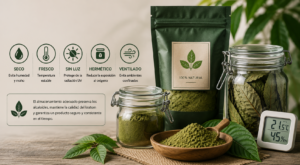
Another important aspect is the influence of storage conditions on the rate of these transformations. Factors such as temperature, humidity, light exposure, and oxygen availability determine the kinetics of degradation. In controlled environments, aging can be relatively slow and predictable, whereas under suboptimal conditions it may accelerate significantly, leading to a more rapid loss of chemical stability.
It is important to note that, unlike other products where aging may enhance certain properties, there is currently no solid scientific evidence supporting a systematic improvement in kratom’s chemical profile over time. In most cases, aging should simply be interpreted as the natural evolution of the plant material rather than as a controlled optimization process.
Overall, the difference between fresh and aged kratom lies in a series of gradual transformations that affect both the alkaloids and other plant components. These changes are not necessarily dramatic, but they are sufficient to modify the product’s overall profile. Understanding aging as a continuous chemical process influenced by multiple variables allows for a more accurate interpretation of the differences observed in commercial kratom products and reinforces the importance of proper storage practices to preserve stability over time.