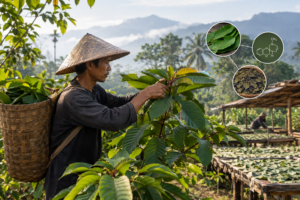
The classification of kratom into green, red, and white varieties is widely used in the marketplace. However, from a scientific perspective, these categories do not represent clearly defined botanical differences, but rather variations resulting from post-harvest processing methods. Although color is the most visible characteristic, the actual differences among these types of kratom are related to changes in chemical composition induced by factors such as drying, oxidation, and environmental conditions during processing.
From a phytochemical perspective, all kratom varieties originate from the same plant species, Mitragyna speciosa, meaning they share a common alkaloid foundation, with mitragynine being the predominant compound. However, the relative proportions of these compounds and the presence of secondary metabolites may vary depending on how the leaves are handled after harvest.
In the case of green kratom, processing is typically carried out under controlled conditions that limit oxidation. Drying in indoor environments or with minimal exposure to solar radiation helps preserve both chlorophyll and the original structure of the alkaloids to a greater extent. As a result, the chemical profile of green kratom is often considered relatively close to the native state of the fresh leaf, with a lower presence of compounds derived from oxidative processes.
White kratom, on the other hand, is generally associated with faster drying and a significant reduction in the wilting phase. This approach minimizes enzymatic activity and limits the chemical transformations that can occur after harvest. From a chemical standpoint, this means that many of the compounds present in the fresh leaf are preserved with less alteration, although variability remains high due to factors such as leaf maturity and cultivation conditions.
Red kratom represents the opposite end of the processing spectrum, as it typically involves more prolonged exposure to conditions that promote oxidation. This may include sun drying, piling leaves under elevated humidity and temperature conditions, or combinations of different drying stages. These processes encourage the transformation of original compounds and the formation of secondary products, resulting in a more modified chemical profile compared with green or white kratom.
At the molecular level, these differences do not necessarily imply the appearance of entirely new alkaloids in large quantities. Rather, they involve changes in relative proportions and the possible formation of derivatives through oxidation reactions or partial degradation. The available scientific evidence suggests that the differences between colors are not as pronounced as they are often portrayed in commercial settings, and that there is considerable overlap among the chemical profiles of different kratom types.
Another important consideration is that visible color is not always a reliable indicator of chemical composition. Factors such as chlorophyll degradation, pigment oxidation, and drying conditions can significantly influence the appearance of the product without necessarily reflecting proportional changes in the primary alkaloids. Therefore, classifications based solely on color should be interpreted with caution from a scientific perspective.
Overall, green, red, and white kratom can be understood as the result of different processing pathways within the same botanical system. The observed variations arise primarily from the interaction of physical and chemical factors during drying and storage, rather than from intrinsic differences between plants. This perspective allows traditional categories to be reinterpreted as processing phenotypes rather than as clearly differentiated chemical or biological entities.