The concept of “fermentation” in the context of kratom is widely used within the marketplace, but its actual meaning from a scientific standpoint is often imprecise or even incorrect. Although certain post-harvest processing methods may create conditions that resemble fermentative systems, there is no clear evidence that kratom undergoes a defined fermentation process in the classical microbiological sense, as occurs in products such as tea, cocoa, or coffee.
In biochemical terms, fermentation involves the metabolic activity of microorganisms, such as bacteria or yeasts, which transform organic compounds in the absence or limited presence of oxygen, generating specific metabolites such as acids, alcohols, or gases. For this process to occur in a controlled and reproducible manner, an environment with well-defined conditions of humidity, temperature, and substrate availability is required, along with an active microbiota capable of carrying out these transformations.
In the case of kratom, some traditional processing methods include stages in which the leaves are piled, partially covered, or maintained under elevated humidity and temperature conditions for specific periods of time. These practices may create microenvironments where a certain degree of microbial activity could potentially develop. However, the nature of these environments is typically highly variable and poorly controlled, making it difficult to classify these processes as fermentation in the strict sense of the term.
From a chemical perspective, many of the changes observed in kratom during these processes can be explained primarily by enzymatic and non-enzymatic oxidation reactions rather than by significant microbiological transformation. Enzymes naturally present within the leaf, such as oxidases, may remain active for some time after harvest, particularly under conditions of moderate humidity. These enzymes catalyze reactions that modify both pigments and certain organic compounds, contributing to the darkening of the material and changes in its composition.
Furthermore, the combination of heat, humidity, and oxygen can accelerate spontaneous chemical reactions that affect alkaloids and other secondary metabolites. These transformations, although sometimes attributed to “fermentation,” are often the result of well-known physicochemical processes such as oxidation or thermal degradation.
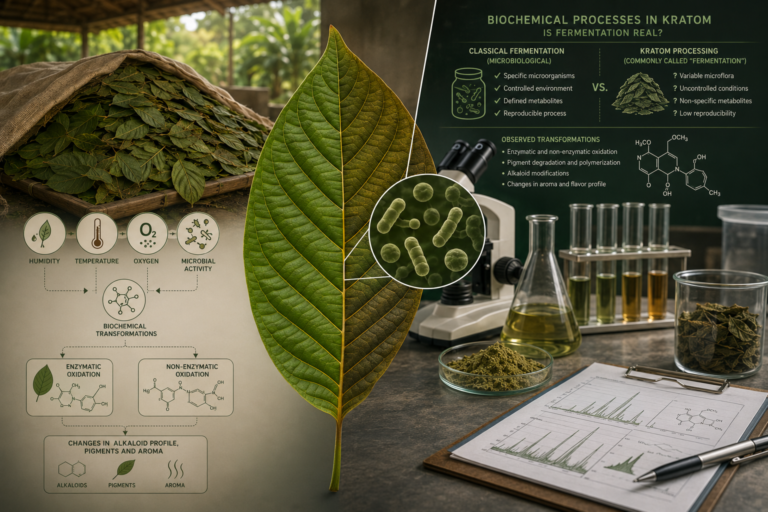
The absence of metabolic profiles clearly associated with fermentation, as seen in other fermented plant products, reinforces the idea that the term is used more as a commercial description than a scientific one.
Nevertheless, the involvement of microorganisms cannot be entirely ruled out in certain specific scenarios, particularly when plant material remains under high-humidity conditions for extended periods. In such cases, limited microbiological interactions may occur, although their exact contribution to the final composition of kratom is neither well characterized nor standardized. This uncertainty is precisely one of the factors that makes it difficult to achieve consistent results across different batches processed under supposedly “fermentative” conditions.
From a quality-control perspective, the use of the term fermentation can be misleading, as it implies a controlled and reproducible process that does not always reflect the reality of kratom processing. In many cases, the differences attributed to fermentation can be more accurately explained by variations in drying methods, oxidation processes, and post-harvest environmental conditions.
Overall, biochemical analysis suggests that what is commonly referred to as fermentation in kratom is, in most cases, a combination of oxidative processes and transformations induced by environmental conditions rather than a defined microbiological fermentation. Understanding this distinction is essential for correctly interpreting differences between products and for advancing toward a more rigorous and scientific characterization of kratom.