
Drying temperature is one of the most critical parameters in the post-harvest processing of kratom, as it directly influences the chemical stability of its alkaloids and, consequently, the final quality of the product. During drying, plant tissue transitions from a metabolically active state to a stable one, but this process is not chemically neutral. The combination of temperature, time, and oxygen exposure determines the rate and extent of multiple reactions capable of modifying the structure of the compounds present in the leaf.
The primary alkaloids in kratom, such as mitragynine and its derivatives, exhibit a certain degree of thermal sensitivity, meaning that elevated temperatures can accelerate degradation or transformation processes. From a kinetic perspective, increasing temperature raises the energy available within the system, promoting oxidation, isomerization, and, in some cases, the partial decomposition of complex molecules. This phenomenon is especially relevant when drying occurs under direct sunlight or in conditions where thermal control is limited.
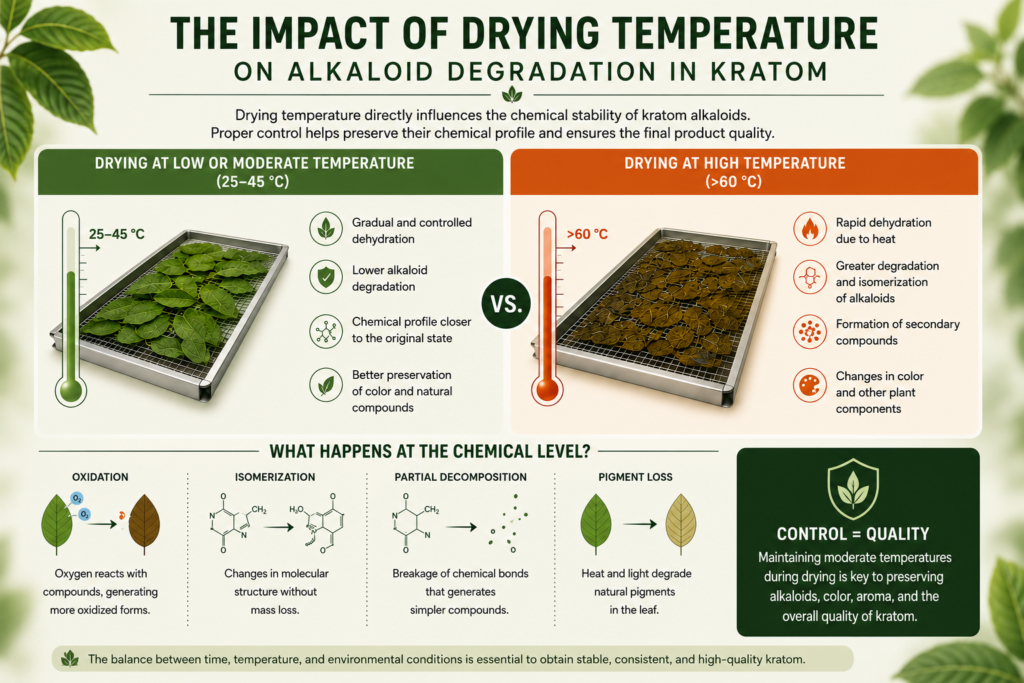
Under low or moderate drying temperatures, moisture removal occurs more gradually, allowing for a more controlled transition toward a chemically stable state. Although certain enzymes may remain active for a limited period under these conditions, the lower thermal energy reduces the likelihood of significant alkaloid degradation. As a result, the chemical profile tends to remain closer to that of the fresh leaf, with less formation of secondary compounds.
By contrast, when drying is carried out at elevated temperatures, the rate of dehydration increases, but so does the intensity of chemical transformations. Prolonged exposure to heat may cause the breaking of chemical bonds or the structural reorganization of certain alkaloids, generating secondary products whose presence alters the overall profile of the material. In addition, heat can affect other components of the plant matrix, such as pigments, leading to visible changes in kratom coloration.
Another relevant aspect is the interaction between temperature and oxidation. As temperature rises, oxygen diffusion and the rate of oxidative reactions also increase, which may promote the conversion of certain compounds into more oxidized forms. This phenomenon affects not only alkaloids, but also other secondary metabolites, contributing to the chemical complexity of the final product.
However, these processes are not entirely predictable, as they depend on multiple simultaneous variables, including residual moisture, plant material density, and environmental conditions.
It is important to note that degradation does not always imply a complete loss of chemical activity, but rather a transformation of the original profile. In some cases, temperature-induced changes may lead to new compound ratios, helping explain part of the variability observed among different commercial products. Nevertheless, from a quality-control perspective, the objective is generally to minimize these transformations in order to preserve consistency between batches.
From a practical standpoint, temperature control during drying represents a balance between efficiency and chemical stability. Drying too slowly may encourage prolonged microbial or enzymatic activity, whereas excessively rapid drying at high temperatures can induce thermal degradation. For this reason, more controlled methods tend to employ moderate temperatures and stable environmental conditions that allow progressive dehydration without compromising the molecular integrity of active compounds.
Overall, drying temperature not only affects the appearance of kratom, but also serves as a determining factor in its final chemical composition. Understanding its impact from a scientific perspective makes it possible to better interpret the differences between products and underscores the importance of post-harvest processes in defining kratom quality.